Family circle
A repeated act of care, humor, practical help, or presence described without publishing family conflict or obligation.

Contribution around them, possibility ahead
Gather true scenes from family, friends, craft, work, and community—then build a chorus around what this chapter makes newly possible.
Start the song
Replace each blank with real names, moments, and details—the more specific you are, the less generic the song. Everything stays editable in the studio before anything is generated.
What you are making
At sixty, one person may be changing work, another deepening it, another caring for family, another traveling, another learning a first instrument, and another wanting no public story about age at all. A personalized 60th birthday song should ask what the milestone makes possible instead of assigning retirement, health, grandchildren, leisure, or decline. The answer may be more time, but it may also be greater authority, a new craft, chosen community, or freedom from somebody else's timetable.
Creatune uses a contribution constellation rather than a conventional biography. The agent gathers scenes from two or three circles—family, friends, work or craft, and community—then finds the repeated action connecting them. It asks who owns each memory, what should remain private, and what future the recipient actually names. For a large event it also checks hearing, pacing, room size, lyric clarity, contributor approval, and playback logistics so recognition reaches the person the track was made for.
The contribution constellation
Contribution is clearest in repeated actions, not ceremonial praise.
Draw four circles: family, friendship, craft or work, and community. Ask each circle for one directly witnessed action. Family may remember the weather report sent before every journey. Friends may know the repair kit that appears on every trip. Colleagues may describe the question that slows a rushed decision. A choir, club, garden, neighborhood, faith group, mutual-aid table, or team may know how the recipient turns newcomers into participants. Select two or three circles with real evidence; do not force all four.
Then identify the repeated practice beneath them: preparing, translating, inviting, fixing, teaching, noticing, organizing, feeding, listening, or making. Recognize its effect without calling the recipient endlessly selfless or indispensable. If the song only praises what they do for others, sixty becomes another demand. Include what receives no audience—the sketchbook, early swim, radio repair, language lesson, or long walk—so the chorus returns ownership of the next chapter to the person being celebrated.

A repeated act of care, humor, practical help, or presence described without publishing family conflict or obligation.
The ritual, trip, call, meal, game, or rescue friends directly witnessed and still recognize.
A method, standard, question, object, or teaching moment rather than a title or award list.
How the recipient helps others enter, learn, contribute, or stay—without claiming ownership of the whole group.
The future-freedom planner
Future freedom may be structural: fewer shifts, more control over projects, the ability to travel outside school holidays, a room finally available for making, a return to study, or a weekly day with no caregiving schedule. It may be relational: being more available to friends, moving closer to family, or protecting solitude. It may be imaginative: beginning a language, joining a band, restoring a boat, documenting recipes, mentoring by choice, or continuing exactly the work they love with better boundaries.
Name one immediate possibility and one long horizon. Avoid bucket-list pressure and the claim that time is running out. Do not assume the recipient wants adventure, grandchildren, a second career, or constant productivity. The useful chorus sounds like permission supported by history: because this person has spent years making room for others, they can choose which room is theirs next. If the future is uncertain, celebrate options rather than pretending a settled plan.
A schedule change, protected day, slower route, or more deliberate pace named by the recipient rather than inferred from age.
A room, garden, route, city, studio, boat, workshop, or table where the next chapter can become tangible.
A craft, study, movement, community role, curiosity, or work method they want to deepen without performance pressure.
Relationships they want to choose more freely, including solitude, without assigning care duties or family roles.
Warm sound, intelligible story
Warm Motown-inspired instrumentation can carry several contributor circles with a steady groove, melodic bass, bright guitar, and a chorus built for response. A folk ensemble suits stories rooted in craft, travel, community, or family objects, especially when acoustic instruments leave room for diction. Cinematic pop can move from a private scene into a wide final chorus without implying nostalgia. Describe musical features rather than asking to imitate a named artist.
Accessibility is creative direction, not an afterthought. Ask whether the recipient uses hearing aids, prefers lower volume, needs slower lyric pace, or will sit far from speakers. Avoid dense background harmonies under names and important facts. Test the vocal in the actual garden, hall, or restaurant; outdoor air and conversation reduce intelligibility. Printed lyrics can be a beautiful companion when they are large enough to read and checked for private details.
Steady groove, melodic bass, bright guitar, optional brass color, and a room-friendly chorus without copying a performer.
Acoustic textures, communal warmth, clear narrative space, and an arrangement suited to craft or place-based scenes.
A controlled build from one quiet action into a broad future-facing chorus with clean vocal placement.
Moderate lyric density, verified pronunciations, comfortable volume, speaker placement, and optional printed lyrics.
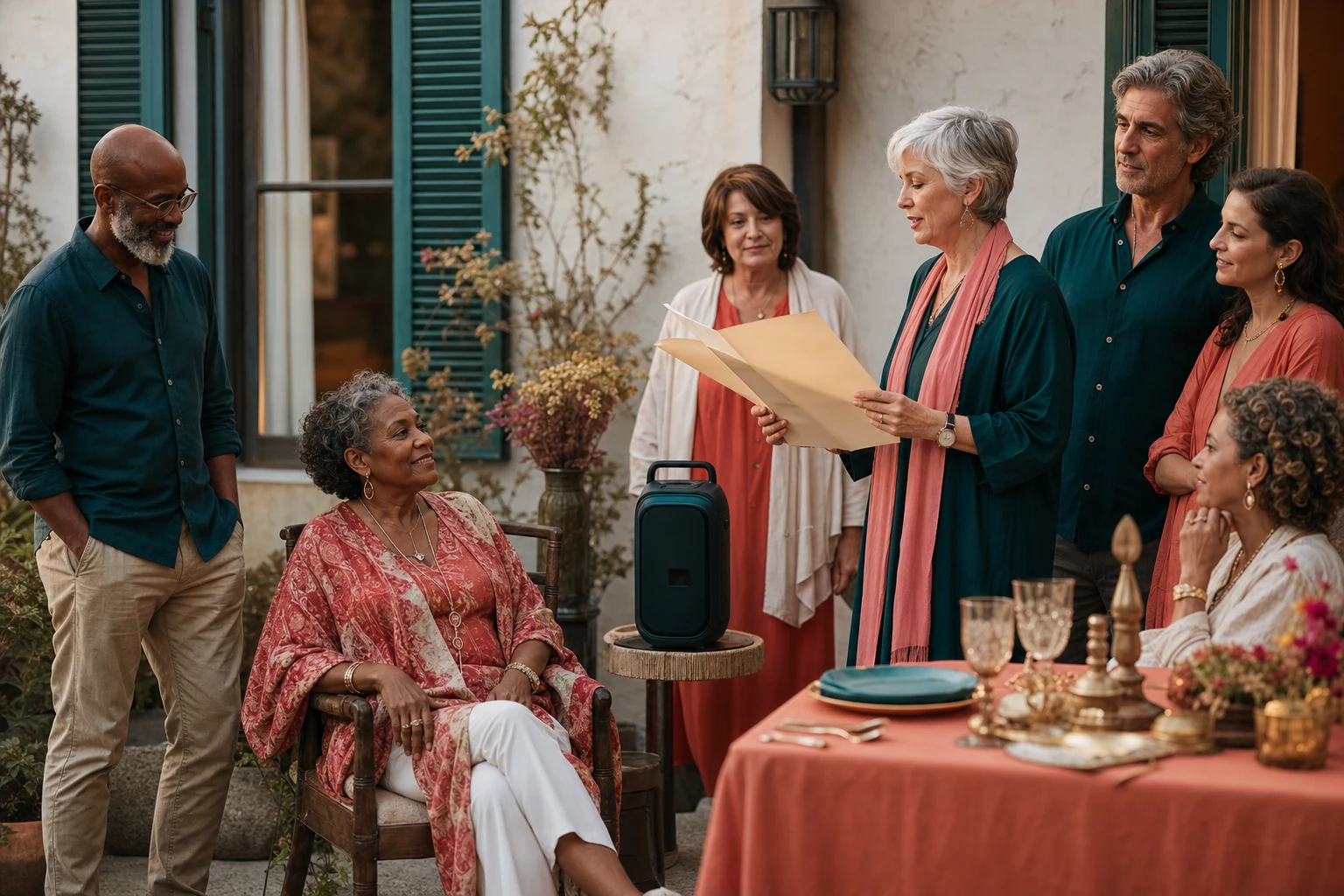
A constellation in the room
Assign each contributor circle one prompt and one deadline. Ask for witnessed scenes, not adjectives. A single editor should remove duplicate stories, verify facts, and flag assumptions about work, retirement, family, health, or age. Before the event, share the final lyric with the recipient's trusted person when the song is a surprise. Confirm the cue, room volume, screen use, seating, and whether a spoken introduction would incorrectly frame the birthday as a farewell.
At a garden party, place speakers where the vocal reaches the recipient without overwhelming conversation. Use a short, strong opening cue and play before the room fragments. For a smaller family gathering, combine the track with a map or constellation of objects from each circle. Keep a master file on two devices. Afterward, send the audio and lyric privately so the recipient can hear details missed in the room and decide whether the song should be shared more widely.
One witnessed action per circle, clear ownership, no copied praise, and a final editor responsible for consistency.
Birthday framing stays distinct from retirement, farewell, memorial, medical, or family-role narratives unless explicitly accurate.
Speaker placement, lyric pace, seating, comfortable volume, large printed text, and a tested downloaded file.
Private post-event copy and the recipient's choice about future sharing, video posting, or wider distribution.
Story examples
These are transparent story examples, not fake audio demos. They show how real details become a creative direction and a singable lyrical moment.

Story Example
Ruth turns sixty at a garden gathering. Family remembers her sending route maps before every trip, friends know the spare key she keeps for anyone arriving late, and the community orchestra knows how she welcomes first-time players. She is not retiring and does not want health or grandmother language. She hopes to learn cello next year.
Direction: Warm Motown-influenced soul with melodic bass, bright guitar, soft brass, and clear lead diction. Use the spare key to connect all three circles and turn the last chorus toward becoming a beginner on cello.
Story Example
Omar turns sixty privately. His partner wants to connect years of carpentry, weekend walks with friends, and the care he gave an older neighbor without calling him selfless. He has reduced one workday to study local history and travel by train. Exclude finances, retirement, health, and family pressure.
Direction: Folk ensemble with acoustic guitar, upright bass, brushed percussion, mandolin color, and a close vocal. Let wood grain and folded rail maps connect contribution with future time, keeping the lyric grounded rather than heroic.
Story Example
Anika turns sixty at a mixed dinner and continues leading public-interest projects. Colleagues recognize the question she asks before rushed decisions; her children remember the same pause before family plans. She is taking a photography course, not stepping away from work. Keep project names and family disagreements private.
Direction: Cinematic pop with piano, muted pulse, low strings, and a wider final chorus. Repeat the question as an action rather than quoting confidential language, then move from slowing rooms to choosing what she photographs next.
Keep exploring
A birthday song that knows the person
Five chapters, one unmistakable chorus
A living oral history the whole room can hear
Questions before you create
Include the recipient and contributor circles, one directly witnessed action from at least two circles, the repeated practice connecting them, and what this chapter makes newly possible. Add exclusions for retirement, health, family roles, or private history, plus event scale, hearing or pacing needs, and a musical direction.
No. Retirement is a separate life event and should appear only when accurate, welcomed, and relevant to the recipient. Sixty may involve continuing work, changing its shape, learning, caregiving, travel, community, or no structural transition. Creatune asks what the age enables rather than importing a farewell narrative.
Ask family, friends, work or craft, and community for one witnessed action each. Choose two or three circles with the strongest evidence, identify the practice connecting them, and keep extra names in a card or video credits. One repeated action gives the chorus more shape than a catalogue of praise.
Use moderate lyric density, clear name pronunciation, comfortable tempo, and a vocal-forward mix. Test speakers at event volume, place them near the recipient without overwhelming the room, provide large printed lyrics when useful, download the file to two devices, and confirm whether hearing aids or seating affect playback.
A 60th birthday song maps contribution and future possibility across the whole life without assuming work is ending. A retirement song focuses on a specific career transition, colleague audience, workplace facts, handover, and next chapter. If both events coincide, decide which emotional job leads and keep the other secondary.
Your turn
Bring two witnessed actions, one future possibility, and the boundaries that keep the story accurate. The agent will map the constellation.
Create a 60th birthday song